IPTV Subscription Length: 4 Smart Ways to Choose Better
By POD IPTV · Updated 10 October 2026 · 9-minute read
IPTV subscription length determines how long you commit before reviewing the service again. A lower monthly equivalent can be attractive, but the full prepaid amount, your experience with the setup and changing household needs matter too. This guide helps UK viewers compare short and long terms using four practical decisions, rather than assuming the longest plan is automatically the right one.
1. Match IPTV subscription length to how much you know
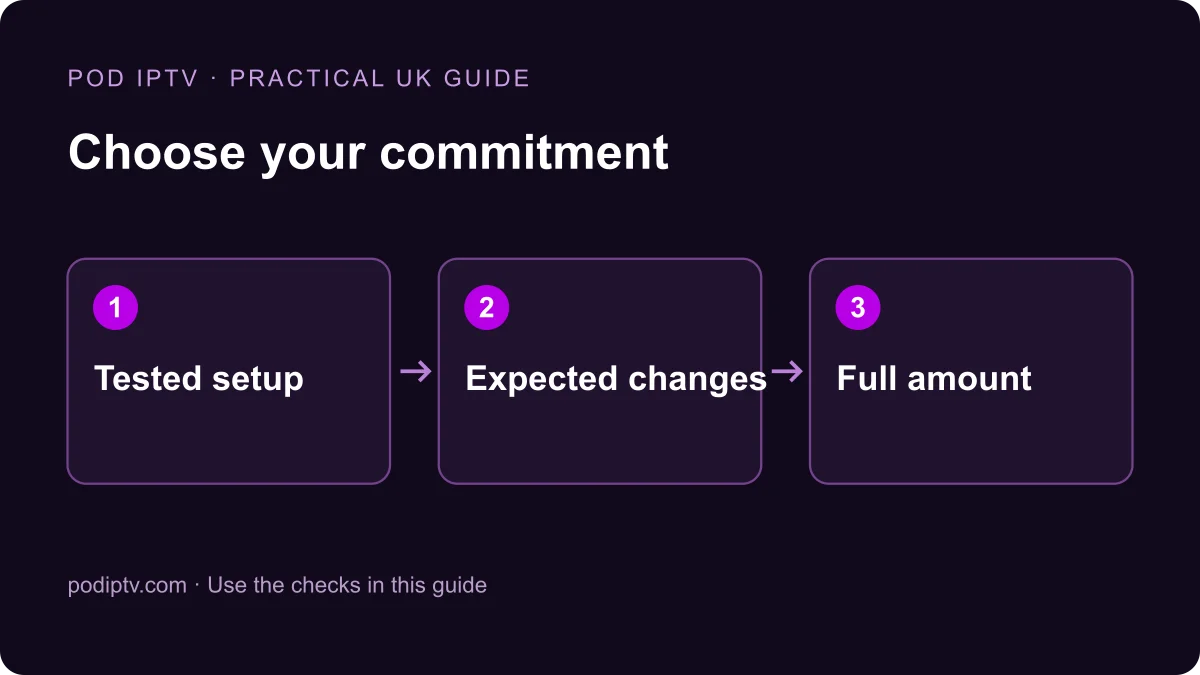
A new customer has less evidence than someone who has used the same service comfortably for several months. Start by identifying what remains untested: the player, the main television, evening connection conditions, required programmes or support process. A longer term increases commitment while those uncertainties remain.
A short term can provide time to observe everyday use beyond a trial. That does not make it a guarantee of future reliability, but it gives more evidence than a brief demonstration. The useful question is how much money you are comfortable committing before you have that experience.
If you already know the service fits, a longer IPTV subscription length may offer a lower monthly equivalent. Compare the full payment and duration rather than a headline reduction alone. Choose with a realistic understanding of what you have tested and what can still change.
2. Match the term to your household's likely changes
Consider moves, equipment replacements, broadband changes and different viewing patterns. A household expecting a major change soon may value a nearer review point. Another household with a stable setup may be comfortable planning further ahead. Neither choice requires pretending to predict every future circumstance.
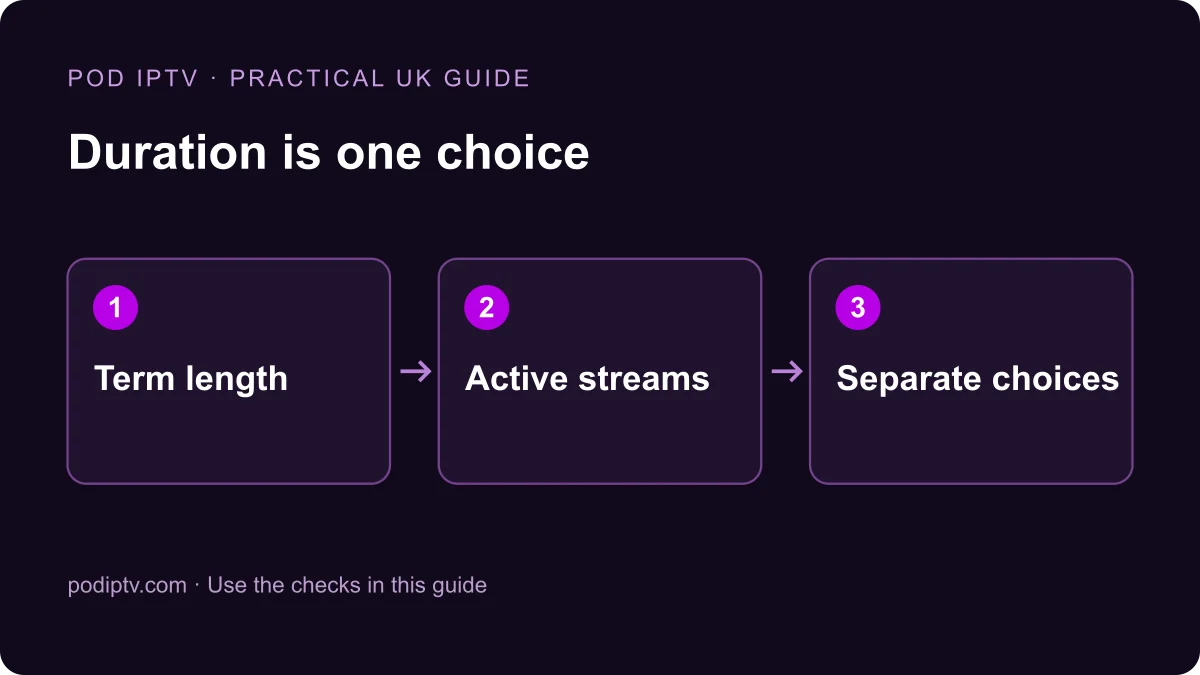
Count simultaneous use separately from duration. A six-month one-device option and a six-month two-device option cover different needs. Do not choose extra connections merely because you own more screens, or assume a longer term automatically expands the allowance.
Ask whether changes during the term are supported and under what conditions. An upgrade, transfer or account alteration should not be presumed available without confirmation. The current POD IPTV support route can clarify the intended arrangement before you rely on it.
Write down the household's non-negotiable requirements: two screens together in the evening, a specific language option, accessible controls or a supported television model. IPTV subscription length should follow confidence that these requirements are met, not distract from checking them.
3. Compare commitment with the monthly equivalent
The full amount is the money committed under a prepaid option. The monthly equivalent divides that amount by the term. Both are useful, but they answer different questions. The equivalent shows comparison across time; the full amount shows what leaves your budget at purchase.
Use the live pricing page for current terms and amounts. Compare the same simultaneous allowance when comparing duration. Mixing one-device and three-device figures can make a term appear more or less expensive for the wrong reason.
Questions by IPTV subscription length
Term approach
Why consider it?
What to verify
Shorter commitment
Earlier chance to reassess fit
Full amount and review date
Medium commitment
Balances planning and a later review
Expected household changes
Longer commitment
May reduce the monthly equivalent
Confidence in setup and full prepaid exposure
Waiting to decide
Useful when compatibility is unclear
Resolve the unanswered requirement first
A discount does not prove reliability or content rights. A longer term can be financially appealing while still being unsuitable for an untested device. Keep service quality, programme availability and purchase conditions in the comparison rather than treating arithmetic as the whole decision.
Do not describe a prepaid term as monthly billing unless that is actually the arrangement. Keep the end date in your budget record and set a review reminder. Rounding the monthly equivalent is fine for comparison, but use the full advertised amount when recording the purchase.
4. Understand expiry, renewal and policies
Confirm when the term begins and ends. Request submission, payment and activation may be distinct events, so ask for the account's actual dates. Retain the confirmation privately. A clear end date makes the chosen IPTV subscription length easier to manage.
POD IPTV presents prepaid options without automatic renewal. Check the current terms for the arrangement and refund policy for conditions and the request process. Do not assume every reason for changing your mind is covered by a short headline.
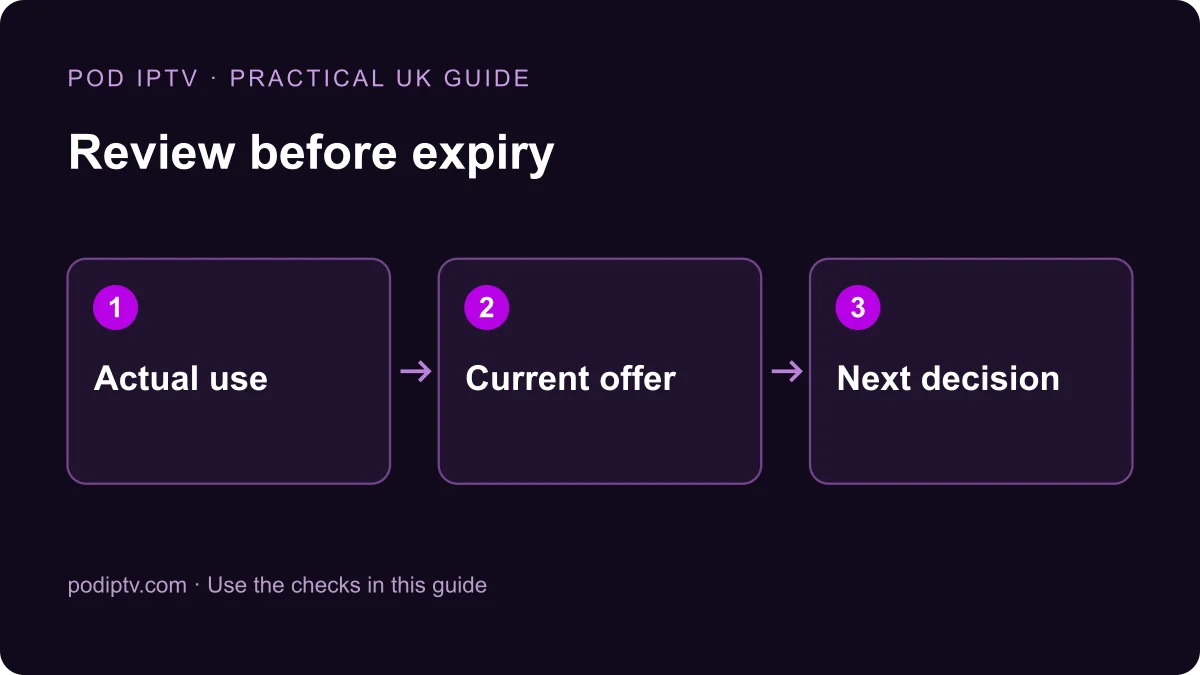
Review the current offer again at renewal. A remembered price or previous discount should not be treated as a promise for a future term. Confirm the applicable amount, connection allowance and any account changes before making another commitment.
If access stops near expiry, check account status before deleting the player. An expired service and a broken application require different actions. Paying an app licence also does not automatically renew programme access.
Evaluate a service before selecting the term
Use your normal viewing device, room and time. Test a few real programmes and the controls you depend on. Check guide navigation, favourites, captions or audio options where available. A successful test on someone else's phone says little about the experience on your living-room television.
The 24-hour trial request page explains POD IPTV's current request process. Confirm activation and the testing period with support. A request is not itself usable access, and a trial should be treated as an evaluation rather than a guarantee of every future programme.
After a trial, record what remains uncertain. Perhaps playback worked but a required player fee is unclear. Perhaps the main screen works but a second room has not been tested. Resolve those questions before selecting an IPTV subscription length based solely on the lowest equivalent price.
Do not rush a long commitment to avoid a vague countdown. If an offer has a genuine end date, establish its conditions, but do not substitute urgency for understanding the purchase. A suitable plan remains a combination of fit, acceptable commitment and clear terms.
Three examples of different sensible choices
A first-time viewer has a compatible television but has never used the player. Their trial reveals that playback works while remote navigation still needs practice. A nearer review point may be useful while they learn whether the setup remains comfortable through ordinary evenings.
A household that has used the same account and devices successfully has stronger evidence. It can compare a longer term's full amount with the benefit of a lower monthly equivalent. It still checks current conditions instead of assuming past experience guarantees future availability.
A family planning to move soon knows its broadband and room layout may change. It may prefer to review the service after that change, even if a longer term is cheaper per month. The decision reflects a specific uncertainty rather than a claim that long terms are always bad.
In all three examples, IPTV subscription length follows the household's confidence and plans. There is no universal correct term. The aim is to make the trade-off explicit enough that the buyer can explain the choice without relying on a sales slogan.
Build a review reminder that is actually useful
Choose a reminder before the end date that leaves time to ask questions. Include the account reference, chosen allowance and where to check current pricing. Keep credentials out of shared calendars or notification text that other people can see.
Protect the email account used for confirmations and recovery. The NCSC explains two-step verification as an extra check on sign-in. Use it where available on important accounts, while keeping service-supplied access details private.
At review, ask whether the service still matches your programme needs and whether all normal devices work. Check if simultaneous viewing has changed. A new television or another household member's routine may alter the connection allowance you need even if the preferred duration stays the same.
Look at any recurring support issues and their outcomes. An isolated brief interruption is different from a persistent unresolved problem. Base the decision on a fair record of normal use, not only the most recent good or bad evening.
If you decide not to continue, understand what happens at expiry through the current terms. Do not assume uninstalling the player changes a service agreement. Conversely, retain any separately purchased player licence according to its own conditions; it is a different product.
IPTV subscription length and equipment purchases
Do not combine hardware replacement and a long service commitment before establishing compatibility. If you need a new device, confirm that it runs the required player and account format. The device guides help distinguish platforms.
Keep the hardware seller's returns policy separate from the service policy. A refundable device purchase does not imply a prepaid account can be refunded under the same conditions. Record receipts and dates for each item.
If existing equipment works, there may be no reason to buy another box. That can make the budget easier to understand and reduce the number of variables in testing. Upgrade when a demonstrated limitation justifies it rather than because the subscription page includes a device picture.
The right IPTV subscription length should remain suitable after the equipment decision. A device with poor controls can make a low-cost long plan feel less useful. Solve the everyday experience first, then decide how long to commit to using it.
How to compare the risk without inventing predictions
List what you know, what you can test and what you cannot guarantee. You may know that the current device supports the player. You can test evening playback and required controls. You cannot guarantee that every future network condition, catalogue item or household requirement will remain unchanged.
A longer term reduces the number of renewal decisions but increases the time until the next natural review. A shorter term gives an earlier decision point but may have a higher monthly equivalent. Describe those trade-offs honestly without claiming one is risk-free.
Read policies for the circumstances you are concerned about. If a particular change matters, ask support how it is handled. An understandable answer is more useful than vague reassurance that the service is always perfect.
Do not make a longer IPTV subscription length the default response to a temporary promotion. Make it a deliberate choice based on observed fit and acceptable commitment. That approach remains useful even when prices or offers change.
Questions about IPTV subscription length
Which IPTV subscription length is best for a new viewer?
A nearer review point can be sensible while the setup is still being evaluated. Test compatibility and normal use, then compare the full amounts and conditions.
Does a longer IPTV subscription length include more screens?
Not automatically. Duration and simultaneous allowance are separate choices. Check the specific option you select.
Can I change IPTV subscription length during a term?
Ask support about the current conditions before relying on a change. Do not assume upgrades or transfers are included without confirmation.
Is the monthly equivalent collected every month?
It is a comparison calculation. Under a prepaid option, check the full upfront amount and actual term.
How should I review IPTV subscription length at renewal?
Check current pricing, household use, device compatibility and any unresolved issues. Choose the next term from that evidence rather than habit.
Does a trial settle IPTV subscription length?
A trial helps assess immediate fit. It cannot remove every uncertainty over a longer period, so decide how much commitment you are comfortable making.